
One of the most misunderstood concepts in construction is the difference between delay and disruption.
Many people use the terms interchangeably, yet they measure two fundamentally different project outcomes.
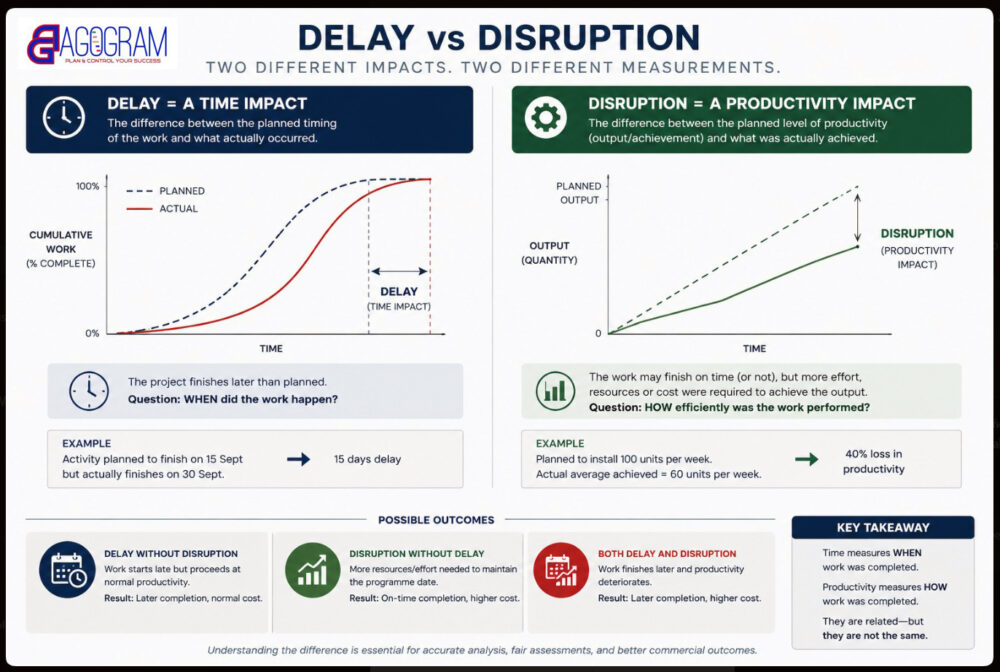
Delay is the difference between the planned timing of the work and what actually occurred, where reality falls behind the original intention.
In simple terms:
Delay is about time.
If an activity was planned to finish on 15 September but actually finishes on 30 September, the project has experienced delay. The question becomes:
“When did the work happen?”
Disruption, however, is something entirely different.
Disruption is the difference between the planned level of productivity or achievement and what was actually achieved, where reality falls short of the intended performance.
In simple terms:
Disruption is about productivity.
The work may still finish on the planned date—or it may not—but the contractor may have required significantly more labour, additional shifts, out-of-sequence working, rehandling of materials, inefficient access, repeated mobilisation, or excessive supervision to achieve the same output.
The question becomes:
“How efficiently was the work performed?”
This distinction is critical because:
- A project can suffer delay without disruption.
Work simply starts late but proceeds at normal productivity. - A project can suffer disruption without delay.
Additional resources recover lost productivity, maintaining programme dates but at significantly higher cost. - A project can suffer both delay and disruption.
The work finishes later and productivity deteriorates during execution.
Understanding this distinction is essential for project controls, forensic delay analysis, extension of time claims, disruption claims, and commercial negotiations.
Time measures when work was completed.
Productivity measures how the work was completed.
They are related—but they are not the same.
One of the most valuable questions a project team can ask is not simply:
“Why was the project late?”
but also:
“What prevented the workforce from achieving the productivity that was originally planned?”
The answer to those two questions often leads to entirely different causes, different contractual entitlements, and different commercial outcomes.
Delay is a time issue.
Disruption is a productivity issue.
Confusing the two can fundamentally change the outcome of a claim.
Here’s a question I often leave clients with:
If your programme shows where you lost time, can it also show where you lost productivity?
That distinction frequently uncovers risks, costs and contractual entitlements that remain hidden until it is too late.
#Construction #ProjectControls #DelayAnalysis #Disruption
#ConstructionLaw #ExtensionOfTime #Planning #ForensicPlanning
#ProjectManagement #ProjectCertainty