
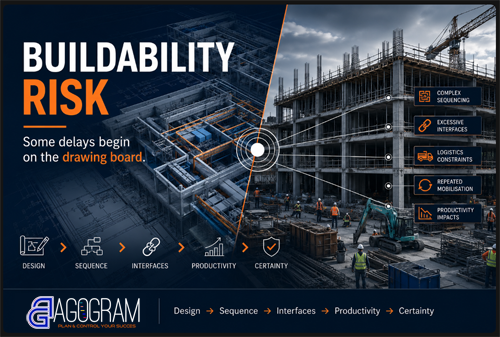
WHEN DELAY IS DESIGNED INTO PROJECT
Buildability is the extent to which a design can be efficiently converted into physical reality. And when buildability is not considered early enough, the consequences often emerge later as:
- difficult construction sequencing;
- excessive interfaces between trades;
- repeated mobilisation and “second visits”;
- constrained access and logistics;
- fragmented work fronts;
- procurement complications;
- reduced productivity; and
- ultimately, delay and disruption.
One of the most important principles of effective programme management is therefore this:
Time control starts during design — not when construction starts.
A technically compliant design may still create significant delivery uncertainty if it forces activities into unnecessarily linear sequences, creates excessive dependencies between trades, or prevents work fronts from progressing independently.
Conversely, good buildability creates options.
It considers simplicity, repetition, zoning, access, logistics, trade continuity and sequencing before those issues become construction constraints.
This is particularly important on complex projects.
Every additional interface between trades creates another dependency that must be planned, coordinated and controlled. As those dependencies multiply, the project becomes increasingly vulnerable to disruption.
The question executives and project teams should therefore be asking is not simply:
“Can this design be built?”
It is:
“Can this design be built efficiently, predictably and in the sequence assumed by our programme?”
That distinction matters.
Because a programme can look perfectly logical on paper while the design quietly makes the planned sequence difficult—or impossible—to execute.
And by the time that becomes visible on site, the project may already be paying for it.
Buildability is therefore not just a design issue. It is a project certainty issue.