
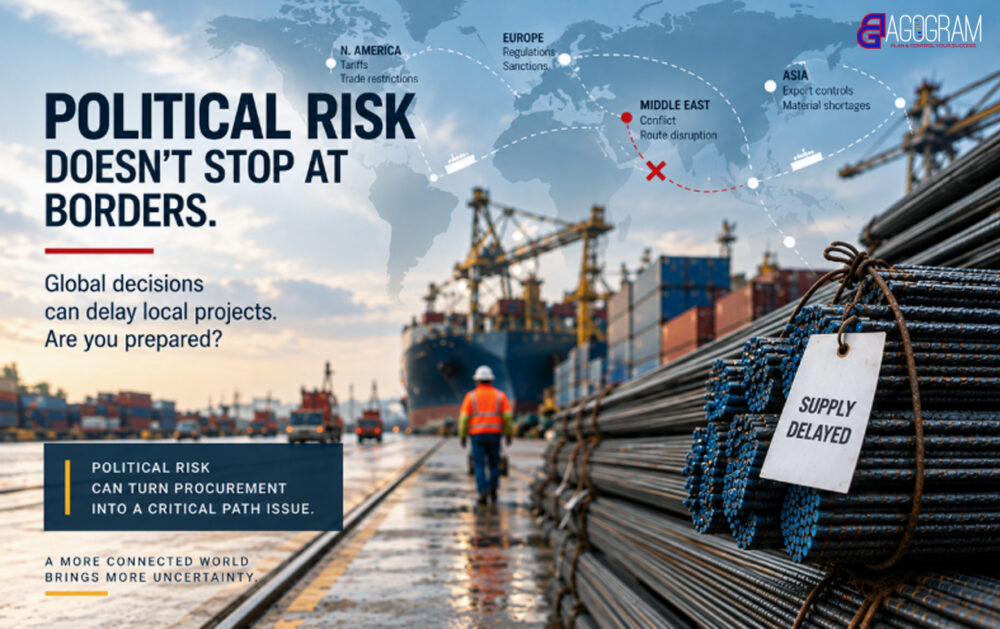
POLITICAL RISK MAY BE CLOSER TO YOUR PROJECT THAN YOU THINK.
Political risk used to sound like something associated with projects being delivered in politically unstable countries.
Not anymore.
A construction project in Australia or anywhere else can be thousands of kilometres from a conflict — and still feel its consequences.
- War in Iran and the wider Middle East.
- The continuing war in Ukraine.
- Sanctions
- Tariffs and trade restrictions.
- Shipping disruption.
- Energy price volatility.
The consequences can eventually arrive at the project gate as higher fuel and material costs, longer procurement lead times, unavailable equipment, disrupted shipping routes and pressure on programme dates.
An old construction management text I recently revisited describes political risk as including changes in government policy, sanctions, import and trade regulations — and even politically inspired industrial action capable of preventing the import of key materials.
What struck me was not that the definition had changed.
It was how contemporary it suddenly sounded.
For contractors and project leaders, perhaps the question is no longer simply:
“Have we allowed for political risk?”
But:
“Do we know where political risk is hiding inside our programme?”
- A critical imported component.
- A single-source supplier.
- A shipping route.
- A fuel assumption.
- A commodity price.
- A subcontractor dependent on overseas materials.
These may appear as procurement or programme risks.
Their underlying cause may be geopolitical.
And when the world changes faster than the project baseline, yesterday’s reasonable assumption can become tomorrow’s critical path.
That is why political risk increasingly deserves to be considered as part of project certainty (Delivery), not simply as a line in the risk register.
For projects with significant international procurement or supply-chain exposure, our team can help examine where external uncertainty may be sitting behind delivery assumptions before it becomes a programme problem.